Hatfield Historical Society

Collection area: Uncategorized

Hatfield Foxfire Reports, 1982-2000

6 boxes (6 linear feet)

The Foxfire Reports were a series of class assignments given to Jr. High and Sr. High School students within the Hatfield, MA, public school system from 1982 until 2000.  Each student or pair of students researched and wrote about a topic relating to the town of Hatfield. Most of the authors incorporated primary documents and personal interviews into their reports.  Both primary source materials and personal interviews have been documented in this finding aid to assist researchers.

A Finding Aid for these reports is available on the website of the Hatfield Historical Society’s Collections page, HERE. There you will several digitized reports on the topic of immigration.

This collection documents a wide variety of topics of interest to scholars of Hatfield, MA, agriculture in New England, and World War II. The interviews with individuals in the People series offer a rich documentation on mid-20th century life in New England, and the projects on the earliest families who settled Hatfield provide a deeper historical context for the town.

Arrangement:

The files in this collection are organized into three series: People, Places, and Subjects. 

The files within the People series are arranged alphabetically by last name, or by family name if there are reports on multiple family members.  Within the Places series, the files are alphabetical by location.  The files within the Subject series, listed alphabetically, include all topics not covered by People or Places. Those topics include businesses, events, organizations, industries and more. If multiple files with the same title exist — such as The Old Mill — they are listed chronologically.
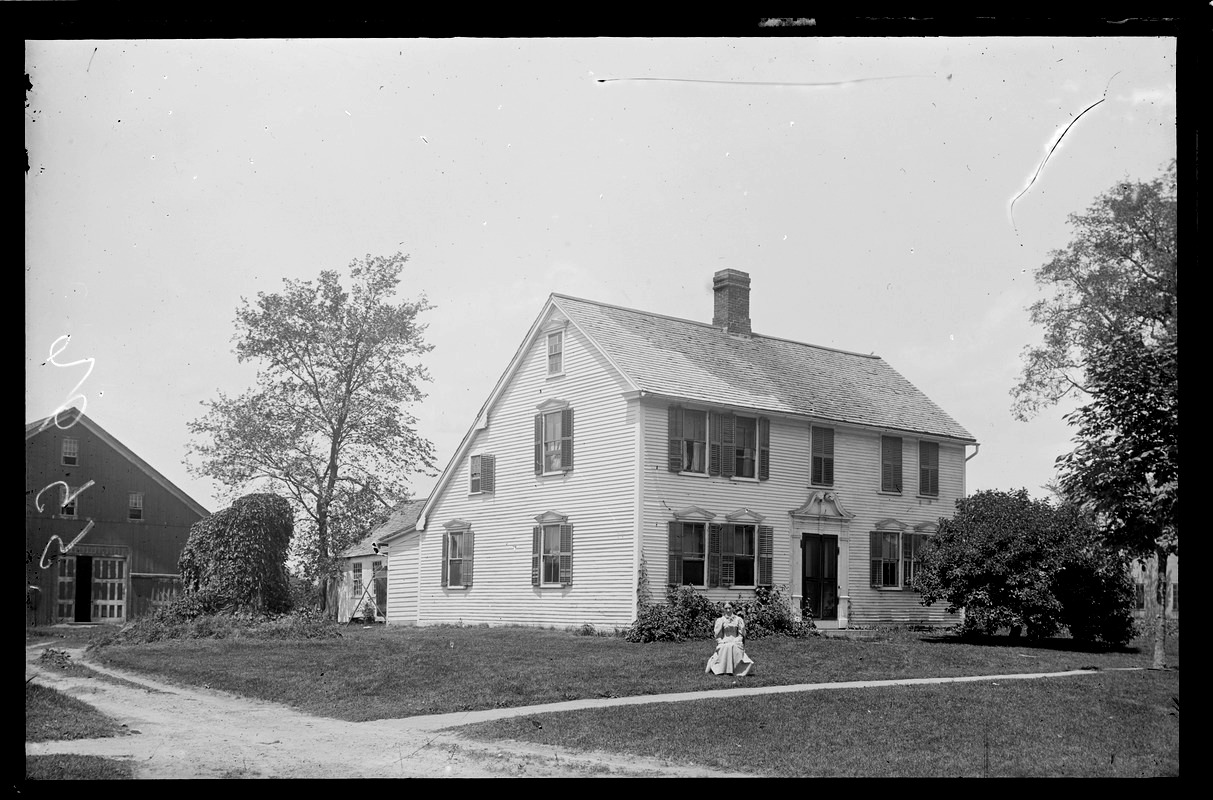
Howes Brothers Glass Slides and Prints, 1886-1907

2 boxes (1.5 linear feet)
18th c. saltbox home, with woman in front yard and barn behind.
Howes Brothers photo of house at 31 Main St., Hatfield, next to brick library and museum.

To access the digital collection on our Digital Commonwealth page, click HERE.

The Hatfield Historical Museum holds a collection of 78 (5×7) glass negatives taken by the Howes Brothers between 1886 and 1907 of houses and other scenes, including tobacco and onion farming, in Hatfield, MA. The three Howes Brothers (Alvah, Walter and George) toured southern New England as itinerant photographers, signing up customers and charging homeowners $1 for 3 prints. Hatfield’s negatives (or glass slides) — the 78 that we still hold — were given to the Hatfield Historical Society by the Ashfield Historical Society in the early 1970s. Ashfield holds about as many additional Hatfield slides as part of its overall collection of more than 23,000 glass negatives produced by the Howes Brothers between 1882 and 1907. These images include Ashfield and other towns from Massachusetts, Connecticut, and southern Vermont and New Hampshire. Please see their website or visit their museum for more information on this astounding collection.

But back to our collection, which has been digitized by the Boston Public Library on our Digital Commonwealth page. You can find it HERE, or at the bottom of the Collections page on the Hatfield Historical Museum‘s website. If you can provide location information or other detail for any of the images, please contact us via our website.

In addition to the glass slides, our collection also holds prints of a larger selection of Howes Brothers Hatfield images, which we have attempted to identify and separate by street location. We believe these prints were made by Ted Hendrick of Southampton, MA, as part of the overall Howes Brothers Project of the Ashfield Historical Society. Many thanks to both the AHS and Ted Hendrick! If you are a longtime Hatfield resident or particularly good at recognizing building features, we would love your help in providing better location info for these prints.

Subjects
  • houses, tobacco farming, onion farming
Types of material
  • glass negatives, b/w prints

Porter & McLeod Machine Shop, 1882-1952 (Bulk: 1882-1921)

30 (30 linear feet)

This collection of business records for Porter Machine Works, starting in 1882, renamed the Porter & McLeod Machine Shop, took a long time and a lot of saviors to get where it is today — inventoried, rehoused into acid-free folders and boxes, and studied by a scholar of local precision manufacturing (thanks to a grant from Mass Humanities!) Our scholar was UMass Lowell history professor Robert Forrant, himself a former machinist.

To get an idea of what that involved, including the nitty-gritty behind-the-scenes work and the grants* that made it possible, check out the post from the curator’s blog HERE.

*It was only three grants at the time of that blog, before the fourth was awarded. They were: 1) a Research Inventory Grant from Mass Humanities, 2) a Supplies Regrant from the Mass. State Historical Records Advisory Board (SHRAB), 3) a Town of Hatfield Community Preservation Act (CPA) grant; and 4) a Scholar in Residence grant from Mass Humanities.

The physical collection is now part of the Hatfield Historical Museum, owned by the Town of Hatfield and managed by the Hatfield Historical Society. You can explore the inventory HERE, and if we can easily answer your questions, we will. As neither the Historical Society nor the Hatfield Historical Museum has a phone, you can reach the museum’s curator at: hatfieldhistoricalsociety@gmail.com

Jonathan E. Porter founded Porter Machine Works in 1882. Its initial location was on one floor of the mill building on the north side of the river, which housed the Shattuck Gun Shop, rebuilt by C.S. Shattuck after the 1881 fire.  Porter then relocated directly across the river (at the falls), and built the shop that still stands today. In 1898, Porter’s shop foreman and son-in-law Hugh McLeod purchased the business for $10,000. Sometime after, the business was renamed the Porter & McLeod Machine Shop. The shop did business across the country and abroad, and closed its doors in 1970.

How did this modest machine shop, tucked away in a small farming town, manage to attract skilled machinists and produce such a thriving business with an international reach for so many years (nearly 90)?

That’s what our Scholar in Residence grant from Mass Humanities (grant #4) addressed.

Subjects
  • precision manufacturing, industrial heritage